A WHMCS alternative your engineers can actually read.
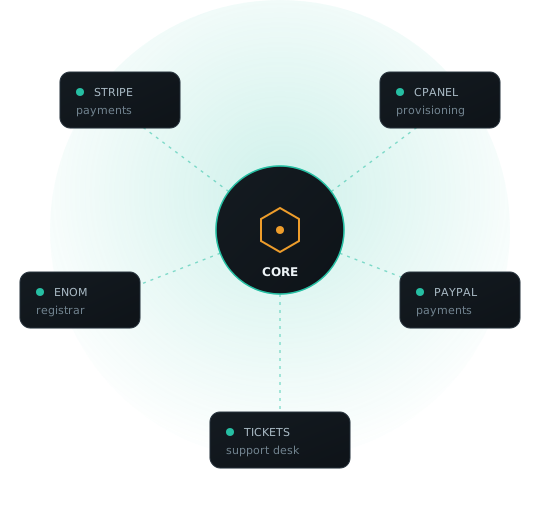
PanelBill is modular, API-first billing and automation for hosting companies that have outgrown WHMCS — a license metered by active client count, up every year since 2023, and no longer sold outright at any price. We're building the replacement on plain, auditable PHP: Stripe, Authorize.net and PayPal for payments, eNom and OpenProvider for domains, no encoded core anywhere.
No credit card. No sales call. Just tell us where to send it.
Billing software grew up. It didn't grow well.
Twenty-five years of "just add one more feature" has left hosting companies with platforms that are expensive to run, hard to secure, and harder to trust.
Nobody uses 90% of it
Legacy billing platforms ship hundreds of features because removing any of them might break someone's workflow from 2011. New staff need a manual to find the button they actually need.
— a recurring theme across independent hosting-software reviewsWhen the docs run out, so do your options
The market leader encodes its core with ionCube. So on the day the software's behavior doesn't match its documentation, there is nothing left to read — you can't trace it, can't patch it, can't hand it to your security team. You file a ticket and wait on someone else's roadmap.
— a recurring theme in public reviews of encoded billing platformsThe bill grows with your client list
What used to be a one-time license is now a subscription that climbs with every client you add — a tax on the exact growth the software is supposed to help you manage.
— a common frustration in hosting-provider communitiesFive decisions we made on purpose
Not features bolted on to win a checklist. Constraints we designed around from line one.
Modular
Payment gateways, provisioners and registrars are independent modules behind one contract. Nothing outside a module touches its vendor code.
API-first
Every action the admin UI takes goes through the same documented API you'd use to script it. There's no hidden path.
Security-first
Mandatory 2FA for staff, encrypted secrets at rest, scoped vendor tokens, and an activity log on every sensitive action. Not an add-on module — the foundation.
Least privilege
Every role, every module, every API token gets exactly the access it needs to do its job — nothing more, nothing standing.
Minimal by default
Core billing, provisioning, domains and support. That's it. We'd rather do less, extremely well, than everything, adequately.
AI belongs inside the workflow, not bolted on top
Hosting providers are already leaning on AI for support — and most are duct-taping it onto a legacy helpdesk. We think it works better designed into the ticket, billing and provisioning core from the start: drafting first-response replies with real account context, flagging fraud and payment risk before it costs you a chargeback, and giving clients a self-service portal good enough that most of them never file a ticket at all.
PanelBill vs WHMCS vs Blesta
If you're shopping for a WHMCS alternative, you should know that "readable code" alone doesn't separate us from Blesta — they ship readable PHP too, and they're cheaper today. What we're building differently is the architecture underneath it: API-first, least-privilege, with AI in the ticket core instead of beside it. Here's the honest version.
| WHMCS | Blesta | PanelBill | |
|---|---|---|---|
| Core source code | Encoded with ionCube | Readable PHP, a few licensing files aside | Plain PHP, no encoder anywhere |
| Architecture | Monolith, bolt-on modules | Monolith with a plugin SDK | Modular by contract |
| Primary interface | UI first, API alongside | UI first, API alongside | API-first — the UI is a client |
| Access model | Broad admin roles | Role-based staff groups | Least privilege, scoped tokens |
| AI in support | Third-party bolt-ons | Blesta AI, as an add-on | Built into the ticket core |
| Pricing basis | Metered by active client count | Flat, unlimited clients | Not set yet — the beta list hears first |
| Migrating in from WHMCS | n/a — it's what you'd be leaving | Free importer built into every install | In development — Blesta ships one today |
Checked against each vendor's own public documentation and pricing, September 2026. If we've got something wrong, tell us and we'll fix it.
The hard part isn't the license. It's the clients already in the old system.
Every comparison in this category argues about price and source code. The thing that actually keeps a provider on software they've outgrown is the migration — years of records, provisioning links and payment plumbing that have to land intact on a Tuesday morning. Here's what we know about that, including the parts that don't favor us.
The records themselves are a solved problem
Clients, contacts, packages, services, invoices, transactions and tickets are the standard set every importer in this market handles — Blesta's has been doing it free inside every install for years.
PanelBill's importer is being built to that same list, and it gets proven on our own WHMCS migration first. We're moving off it too.
Stored payment methods are the part nobody warns you about
Saved cards don't live in your billing software. They live in your gateway as tokens, and all your old system kept was the identifier pointing at one. Carry those across wrong and nothing fails on migration day — renewals just start declining a month later, one client at a time.
That's the piece we're documenting gateway by gateway before we ask anyone to move.
Getting your own data in shouldn't be a line item
Elsewhere it can be. Unmanaged import tools ship with no guarantee attached, managed migrations get quoted case by case, and providers have publicly reported paying several hundred dollars and up simply to move their own records into new software.
An import won't cost extra here. Neither will an export — the way out is part of the product, not a retention lever.
The honest state of it: none of this ships today. PanelBill is in development, and if you had to leave WHMCS this month, Blesta has a working importer and we don't. What we can give you now is the standard we intend to be held to — never migrate in place. Stand the new system up beside the old one, run the import as many times as it takes, reconcile the invoice totals yourself, and cut over only when the numbers match. Anyone promising a one-click afternoon is selling you the afternoon, not the migration.
What this category actually costs
Nobody in this market publishes a straight comparison, so here's one. These are the vendors' own public list prices, checked September 2026.
WHMCS
$34.95/mo
Self-hosted, up to 250 active clients. $54.95 to 500, $84.95 to 1,000, and it keeps climbing from there.
Metered by active client count — the bill grows with the business.
HostBill
$599one-time
Startup edition. Enterprise $999, Data Center $1,599, All-Inclusive $5,999 — the tiers are separated by which integrations you get.
Perpetual, but updates run $125/year after the first, and modules are priced individually.
Blesta
$17.95/mo
Branded monthly; $20.95 unbranded. Owned licenses $350–$1,495. Every tier includes unlimited clients.
Flat and readable — the honest floor this market should be measured against.
Ours isn't set yet, and we're not going to pretend otherwise.
PanelBill is being built to replace the billing system of a working hosting company — ours. We pay one of the bills above every month, which is why growth-metered pricing is on the problem list at the top of this page rather than in a footnote. The price gets set once the beta shows what the thing is actually worth to run, and the waitlist sees that number first.
Get beta access →You're being asked to trust a billing system that doesn't exist yet.
That's a fair objection, and it's the right one. Billing is the system that holds your clients, your invoices and the money coming in — nobody should hand that to a new vendor on vibes. We have no customers to point at, so here is what we can honestly offer instead.
We're customer number one
PanelBill is being built to run the billing for a working hosting company — ours. Every decision on this page is one we have to live with on our own invoices, our own renewals and our own 2 a.m. pages before it ever reaches yours.
We can't ship this and walk away from it. We'd be the ones left using it.
The lock-in isn't the contract. It's the code.
Industry writeups on this market keep landing in the same place: providers stay put because years of data, automation and client integrations sit behind software they can't change, which makes leaving expensive no matter what the license says.
Readable code is the answer to that, which is why it's the reason this company exists rather than a bullet on a feature list.
We'll tell you when someone else wins
Blesta is cheaper than us today and ships readable PHP too — the comparison above says so in our own words, on our own site, next to our own product.
We'd rather lose a signup that was never a fit than win it by being vague about what we are.
And what we won't do: invent testimonials, invent a customer count, or invent a launch date we can't hold. Today the honest promise is small and specific — when there's a beta seat, the list hears first.
Join the beta
We're building in the open and taking a limited number of hosting companies into beta before general release. Leave your email and we'll reach out when there's a seat.